Expanding Capacity Under Load
Across very different areas of life, the same pattern tends to appear when pressure increases.
You can see it in endurance training.
You can see it in operational leadership.
You can see it in financial structure and long-term commitments at home.
The environment changes.
The pattern does not.
When responsibility increases, something inside the system is forced to adapt.
Sometimes the system grows stronger.
Other times the pressure concentrates until something breaks.
Over time I began noticing that the difference was rarely effort.
The difference was capacity.
Not motivation.
Not intensity.
Capacity.
The ability of a person, a team, or a system to continue performing as responsibility grows.
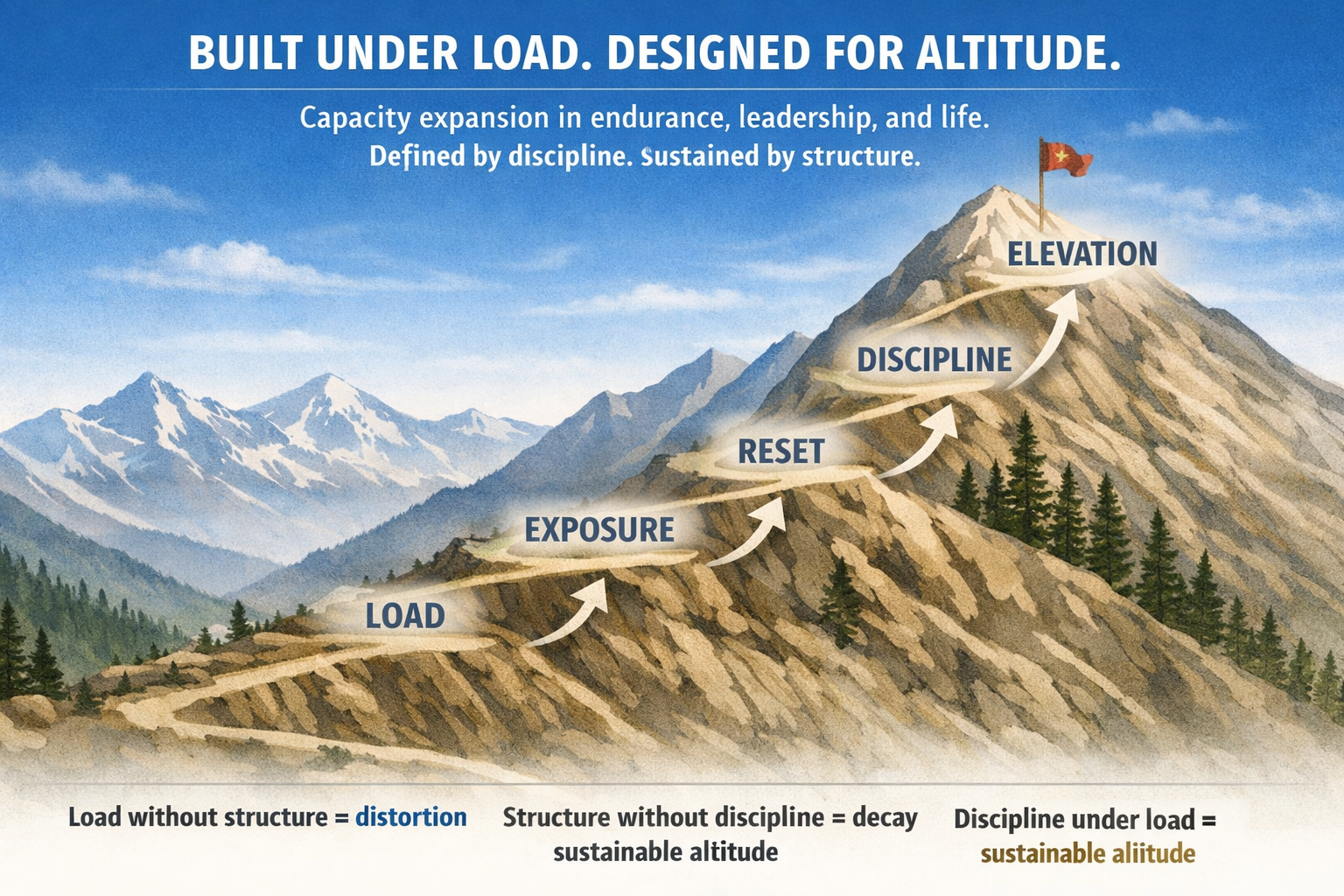
That observation eventually formed the foundation of what I call the Mountain Capacity Framework.
The Pattern Behind Pressure
Pressure rarely appears all at once.
It builds in stages.
Responsibility increases.
Weakness is exposed.
Adjustment occurs.
New discipline forms.
Capacity rises.
Then the cycle repeats again at a higher level.
This progression can be described through five phases.
Load.
Exposure.
Reset.
Discipline.
Elevation.
These phases appear repeatedly in environments where performance matters.
The challenge is not avoiding pressure.
The challenge is growing capacity fast enough to handle it.
Load
Every system eventually encounters increased responsibility.
In endurance training it might be distance, elevation, or pace.
In leadership it might be more people, more projects, or higher expectations.
Load itself is not the problem.
Load is simply the signal that growth may be required.
Without load, capacity rarely expands.
Exposure
When load increases, weaknesses appear.
Sometimes those weaknesses are technical.
Sometimes they are structural.
Sometimes they are simply habits that worked at a smaller scale but fail under larger responsibility.
Exposure is uncomfortable because it reveals gaps.
But exposure is also the most valuable phase in the cycle.
Without exposure, improvement never begins.
This is the moment explored in When Ego Outran Structure, where pressure revealed the limits of relying on individual effort alone.
Reset
Exposure creates a choice.
A system can react emotionally.
Or it can adjust structurally.
Reset is the moment where thinking becomes clear again.
The noise of pressure fades and the focus shifts toward understanding the problem.
In leadership environments this often means protecting the ability to make sound decisions even when pressure rises.
That idea is explored further in Protecting Decision Clarity Under Pressure.
Without reset, exposure simply becomes stress.
With reset, exposure becomes insight.
Discipline
Insight alone does not expand capacity.
The new pattern must be repeated.
Discipline is the phase where adjustments become routine.
New systems form.
Better habits replace old ones.
Structures begin to support the load instead of resisting it.
Discipline is where sustainable improvement begins.
Elevation
Eventually something changes.
The work that once felt overwhelming becomes manageable.
Decisions become clearer.
The system stabilizes at a higher level of responsibility.
Capacity has expanded.
This is elevation.
But elevation is not the end.
As responsibility grows again, the cycle repeats.
Why Leaders Burn Out
Many leaders believe burnout comes from effort.
But in many organizations burnout appears when capacity fails to expand with responsibility.
Decisions compress upward.
Problems flow toward one person.
Responsibility concentrates instead of distributing.
Eventually pressure becomes unsustainable.
This is often not a failure of effort.
It is a failure of structure.
The solution is increasing ownership density across the system so that more individuals are capable of carrying responsibility.
That idea is explored further in Ownership Density: Expanding Capacity Without Burning Out Leaders.
When ownership expands, pressure distributes naturally.
Capacity grows.
Burnout becomes far less likely.
This is explored more directly in Burnout Is Often Structural.
Capacity Determines Altitude
Mountains provide a useful metaphor.
At lower elevations many people can perform well.
But as altitude increases, the environment becomes more demanding.
The same is true in leadership and performance.
Higher responsibility requires greater capacity.
Effort alone cannot compensate forever.
Systems must evolve.
People must develop.
Structure must support the load.
The Mountain Capacity Framework is simply a way of recognizing the pattern behind that process.
Load.
Exposure.
Reset.
Discipline.
Elevation.
Then the cycle begins again.
Each time at a higher altitude.
Built under load.
Designed for altitude.

Leave a Reply