Operation OCALA always has a personality.
No matter how many times you show up, no matter how dialed your training is, no matter what your plan looks like on paper… this race becomes its own thing the moment you step onto the trail. And the best you can do is adapt, stay composed, and keep moving.
This was my third OCALA finish.
And for the second year in a row, I finished in 2nd place.
But this story isn’t about placement.
It’s about what happened out there when the trail stripped everything down to what’s real.
Before the Race — Support, In Every Direction
Before the race even started, I felt something I didn’t expect to feel as strongly as I did: support.
I’ve had people reach out from every corner of my life—friends in the rucking world and friends completely outside of it. Encouragement, check-ins, quick conversations… the kind of support that reminds you you’re not doing this alone.
It was humbling meeting ruckers at the start who introduced themselves and told me they’d been reading the OCALA posts on this blog. Knowing the information helped someone feel more prepared meant a lot—but the credit is theirs. They trained because they committed to it. They showed up because they chose to.
Not everyone finished.
But I have a lot of respect for anyone who was willing to show up and take a real shot at it. OCALA has a way of exposing what you didn’t know you’d have to face—and stepping onto that trail is a commitment on its own.
The Best I’ve Felt Going Into a Race
Leading up to this race, I never felt better physically.
My training was working. My nutrition was spot on. Everything was tracking for an attainable goal time. Coach had me dialed in for the race.
But as you read on—and something I know all too well—what matters isn’t just how prepared you are.
It’s what unexpected shows up during a race… and what you do with it when it does.
A Strong Start — Comfortable Through 24 Miles
This year started the way you hope it will.
From the very beginning I felt good—steady and controlled. Through the first 24 miles I wasn’t forcing anything. My body was working, but it wasn’t fighting. My breathing stayed calm. My movement stayed efficient.
The first 24 miles were exactly what I wanted—controlled, purposeful, and sustainable. And then—somewhere after that—the real fight started. Not in my legs. In my head.
But even early on, the trail was different.
The ground was extra dry. The sand was softer than usual—deep enough to steal energy without making a scene about it. That’s what I love about OCALA. It doesn’t pretend to be predictable. It has its own personality. It gives you what it wants, and you deal with it.
No Distractions — Only Forward
OCALA strips things down to the basics.
There’s no comfort out there. No escape. No real way to hide from what’s going on in your head. You just move forward long enough that the truth shows up—about your fitness, your patience, your discipline… and whatever else you’ve been carrying in life.
The trail doesn’t care how prepared you feel.
It brings you face-to-face with yourself, and then asks you to keep going anyway.
Somewhere Around 30 Miles, It Hit Me
Somewhere around the 30-mile mark, the mental weight arrived.
It wasn’t unexpected. But it was heavy.
The kind of weight you can’t “push through” the way you push through tired legs. The kind of weight that requires you to sit inside it, acknowledge it, and decide what you’re going to do with it.
For the last few months, I’ve been struggling with balance.
Not the clean, polished version of “balance” people talk about online.
Real balance.
Family. Work. Friends. Endurance.
All of it pulling. All of it demanding something.
And me trying to hold it together without dropping anything important.
And out on that trail—alone with no distractions—those thoughts were impossible to set aside.
I Didn’t Find Answers. I Found Support.
I didn’t come up with solutions out there.
But I did something that mattered.
I called my coach.
I called a friend.
And I called my wife.
Because my “why” has shifted so much from the beginning of this rucking story.
It used to be simple: rebuild from broken.
Prove something.
Survive something.
Now it feels different.
Now it feels like I’m trying to bring life back into equilibrium. Not just become stronger—but become steadier.
I needed to get those thoughts out of my head. Saying them out loud made them real, and hearing perspective from someone outside of my own brain helped more than I expected.
And after those calls, the support started coming in while I was still on the trail—texts from the people that matter.
My wife.
My brother.
My coach.
My friends.
Some of them had no idea where my head was at. They weren’t responding to a crisis. They were just being themselves—checking in, encouraging me, reaching out like they always do.
And in that moment, it was exactly what I needed.
In the past, I would’ve ignored it. I would’ve told myself that focus was more important. That staying locked in meant shutting everything else out.
But this time I didn’t need more “focus.”
I needed to know I wasn’t alone.
Those messages didn’t pull me out of the race—they anchored me inside it. And I felt relief in a way I didn’t expect.
The Second Half — Don and I Linked Up Before CP3
The first half of the race had a lot of motion, both on the trail and inside my head.
But the second half is where something shifted.
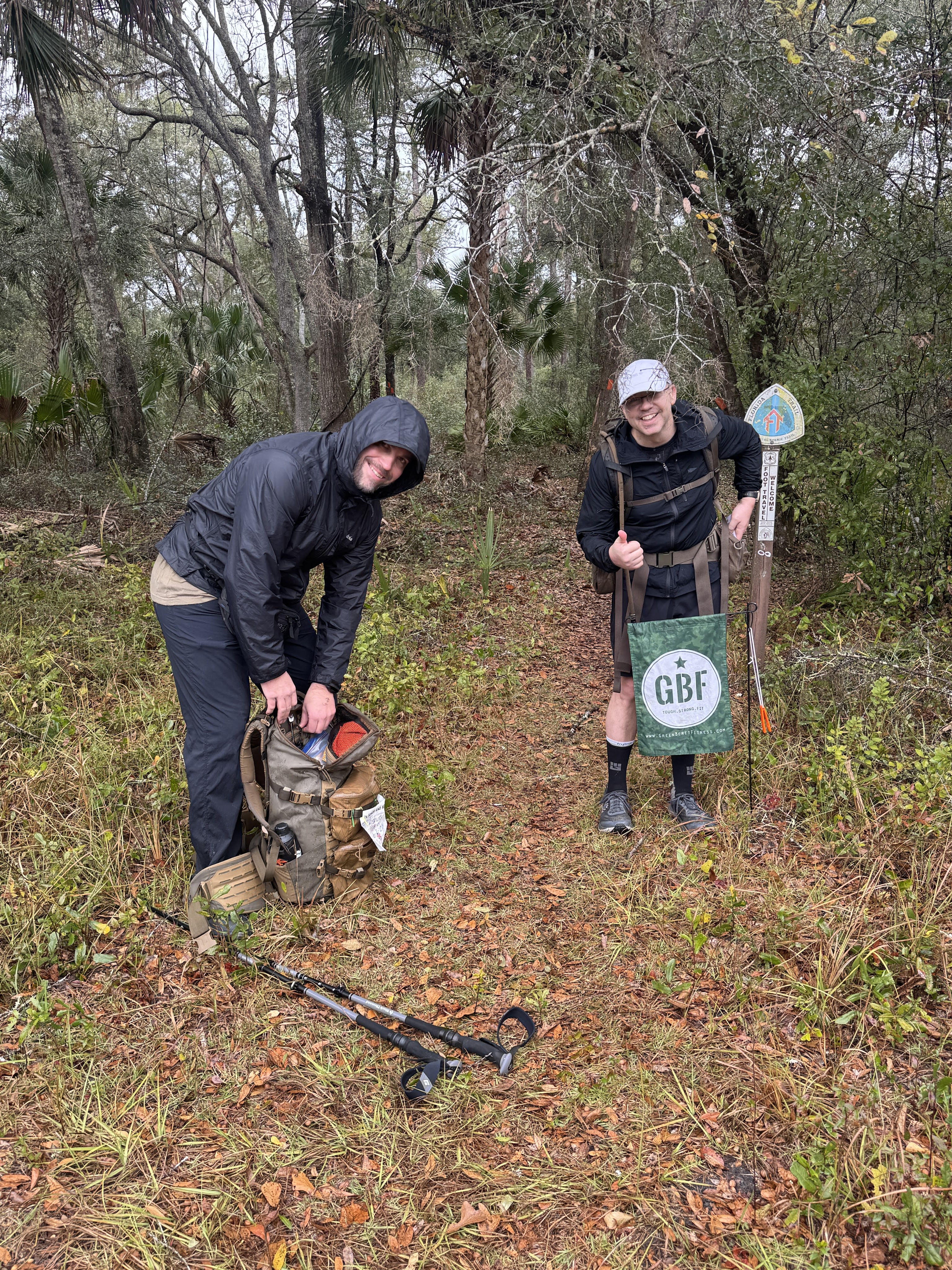
Don Bulgrin caught up to me and we connected just before Checkpoint 3, then stayed together all the way to the finish.
He’s a great guy. Strong and steady. Efficient. Consistent. Always moving forward.
Exactly what I needed.
We had short conversations here and there, but most of the time we just worked. Two guys grinding out miles without needing to fill the silence.
And for me, that was the gift: I wasn’t trapped in my own head anymore.
The Final Miles — Rain, Right on Time
The last 8–10 miles came with rain.
And honestly, it felt fitting.
Gregg—the owner of Green Beret Fitness—called it like he always seems to do. OCALA isn’t complete without something extra in the final stretch. Something that makes you pay attention again when you’re already deep in fatigue.
The rain didn’t ruin anything.
It just reminded me: you don’t control this race.
You only control how you respond to it.
The Finish — Grateful for Another Strong Result
Crossing the line in 2nd place for the second year in a row is something I’m grateful for.
It was a solid day on a course that never makes it easy. The training worked, the preparation mattered, and I executed the way I needed to.
By the time I came into the finish I was tired, hungry, and ready for bed.
And honestly, that’s exactly how OCALA is supposed to feel.
After the Finish — I Needed Space
After the finish, I needed a little time for myself.
In the middle of the race, I didn’t want to be alone. I needed connection. I needed perspective. I needed to hear voices outside my own head.
But once it was over, the switch flipped.
All of a sudden I wanted quiet.
Solo, this race has a way of breaking you down. It finds your weakness in the moment, exposes it, and forces you to face it. Not later. Not when it’s convenient. Right there on the trail.
OCALA Will Always Be Bigger Than a Result
OCALA has a way of putting everything in its place.
It can hand you a strong day on paper—and still make you face parts of yourself you weren’t expecting to meet out there. That’s the part that sticks with me.
The way this course exposes what’s real.
The Lesson Was Support
Maybe the lesson here wasn’t about grit.
Maybe it was about support.
I’ve built so much of my life by carrying everything alone. Handling it. Pushing through it. Not needing anyone.
But this race reminded me that life has changed.
There are good people around me. Real people. The kind who answer the phone. The kind who stay steady when I’m not.
And that matters more than any result.
A Different Kind of Turning Point
Like a lot of races, I know I’ll look back on OCALA and call it a turning point.
But not in a physical way.
Not because I found another gear, or proved I could suffer more, or walked away with a better result.
This one was different.
This was a turning point in life.
A reminder that I can’t keep treating balance like something I’ll figure out “after the next race.” That support matters more than toughness. That the life I’m building outside the trail deserves the same attention I give the miles.
For now, it’s time to rest.
It’s time to recover.
It’s time to get life back into equilibrium.
Because OCALA will always take what it wants.
And the real goal is making sure my life doesn’t quietly lose what it needs.

Leave a Reply