
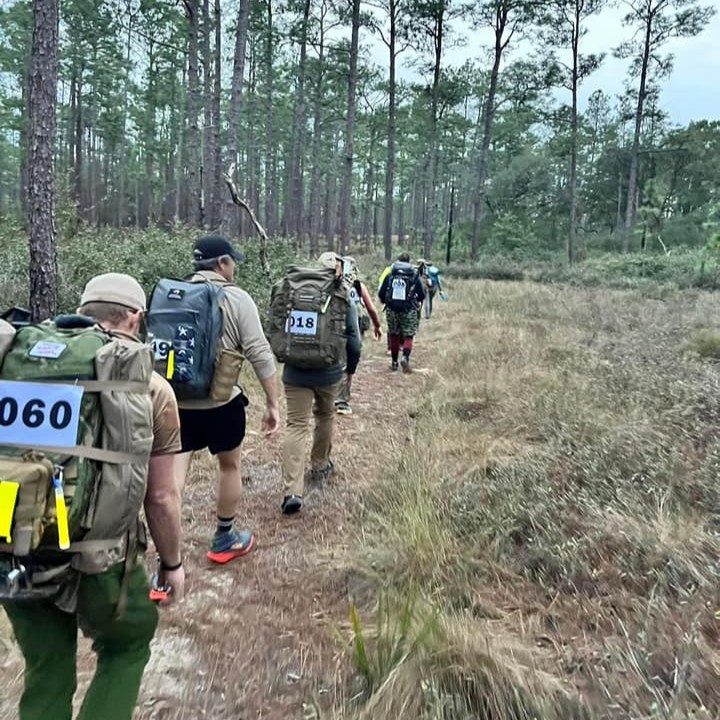
Operation OCALA is not just a long ruck. It is a prolonged test of endurance, execution, and decision-making under fatigue — played out over sand, roots, darkness, and time.
Athletes come to Operation OCALA with different intentions. Broadly, they fall into two groups:
- Those who want to finish
- Those who want to compete
Both paths are valid. Both require respect for the distance. And both are built on the same foundation.
This guide is written for athletes preparing for Operation OCALA, a 67-mile endurance ruck hosted by Green Beret Fitness on the Florida Trail. The goal is simple: help you prepare honestly, execute intelligently, and arrive with a plan that matches your intent.
The Common Ground: What Everyone Must Get Right at Operation OCALA
No one finishes Operation OCALA — and no one competes — without mastering these fundamentals.
Aerobic Engine and Long-Duration Efficiency
Most of OCALA is walked or power-hiked. A strong aerobic base allows you to:
- Move efficiently for long hours
- Recover while still moving
- Stay calm when fatigue and doubt appear
If easy aerobic work feels “too easy,” that’s usually a sign it’s doing exactly what it should. OCALA rewards efficiency far more than aggression.
Durability and Strength Under Load
Strength should reduce the cost of movement, not create fatigue.
Focus on:
- Squats (sandbag or barbell)
- Step-ups
- Calf strength (straight and bent knee)
- Core stability under load
Strong legs don’t win OCALA. Resilient legs finish it — and hold together late.
Navigation on the Florida Trail
Navigation errors quietly end good efforts.
- Study the course ahead of time
- Understand trail intersections
- Avoid blindly following others
- Slow down slightly when uncertain
Navigation is not optional at Operation OCALA. Clean decisions save time, energy, and morale.
Fueling and Hydration for a 67-Mile Ruck
Late-stage fatigue is often nutritional, not muscular.
- Eat early and consistently
- Hydrate before you feel behind
- Prioritize electrolytes
Miss fueling long enough and no amount of grit will save the day.
Gear Reliability Over Novelty
Operation OCALA is not the place to experiment.
- Proven pack
- Broken-in footwear
- Reliable lighting with backups
- Simple, tested systems
Anything that demands attention will cost you later.
Coaching, Structure, and Trusting the Process
My approach to Operation OCALA is not improvised.
I train within a structured coaching framework through Omni Athlete Training Systems, and that structure shapes how I pace, fuel, recover, and make decisions — especially under fatigue.
This isn’t about outsourcing responsibility. It’s about removing guesswork.
Why Structure Matters at OCALA
- Training stress is intentional
- Recovery is respected
- Easy days stay easy
- Hard efforts have purpose
When race day arrives, there’s no need to negotiate with myself. The decisions have already been made.
The Engine Comes Before Everything Else
A core principle reinforced through coaching is building a durable aerobic engine before chasing intensity.
For OCALA, that means:
- Extensive aerobic work
- Controlled intensity where it belongs
- Strength that supports movement, not fatigue
Running at OCALA is not the goal. Being able to run without consequence is.
OCALI as a Case Study: Power Output, Intent, and an Unexpected Outcome
One of the most important preparation blocks for my return to Operation OCALA came from Operation OCALI in November.
I didn’t approach OCALI with a target heart-rate zone in mind. My focus was simpler: manage power output well enough to finish without destroying myself.
At the time, I wasn’t chasing placement, pace, or validation. The goal was completion — intelligently and sustainably — while staying healthy enough to continue training.
A Surprising Data Point in Hindsight
It wasn’t until after OCALI, reviewing the data, that I realized how much of the effort lived in Zone 1.
That surprised me.
But once I stepped back, it made sense.
After a full year of consistent aerobic work, durability training, and restraint — and with no reason to force output — my body naturally settled into an effort level it could sustain for the duration.
There was no intentional throttling. There was simply no need to push.
Why It Worked
- The cumulative aerobic work built over the year
- Improved efficiency under load
- A clear understanding that OCALI wasn’t the place to chase anything beyond a finish
The brief surges into Zone 2 weren’t planned efforts. They were responses to terrain and conditions — followed by an immediate return to control.
That isn’t hesitation. That’s adaptation.
Carryover to Operation OCALA
The real takeaway wasn’t the zone distribution itself. It was what it represented.
- Lower perceived effort doesn’t mean lower preparedness
- Durability allows restraint without fear
- Managing cost early preserves options later
It strengthened my confidence in staying conservative early at OCALA — not because I’m avoiding effort, but because I understand when effort actually matters.
Path One: The Athlete Who Wants to Finish Operation OCALA
Pacing for Finishing
- Calm breathing
- Steady effort
- No urgency to “bank time”
Arriving at the night miles intact is the goal.
Managing Discomfort Without Panic
Discomfort is expected:
- Feet will ache
- Hips and calves will tighten
- Fatigue will rise
Finishers acknowledge discomfort without turning it into a crisis.
Checkpoint Efficiency
- Refill
- Eat
- Address issues early
- Move on
Long stops break momentum and stiffen legs.
Mental Strategy for Completion
Break the event into manageable pieces:
- Mile to mile
- Turn to turn
- Checkpoint to checkpoint
Don’t negotiate with the full distance.
Path Two: The Athlete Who Wants to Compete at Operation OCALA
This path assumes the foundation above is solid.
Athletes who compete at OCALA will shuffle and, at times, run — deliberately.
Running is not the goal. It is a tool.
Shuffling and Running: When It Makes Sense
- Maintain momentum on runnable terrain
- Reduce overall time on feet
- Capitalize on low-cost sections
This only works when breathing stays controlled, form remains relaxed, fueling is consistent, and ego stays out of the decision.
Forced running early almost always shows up later.
Movement Economy Over Speed
- Short, quick strides
- Minimal vertical bounce
- Relaxed arms and shoulders
Competitive athletes don’t look fast. They look efficient.
Fueling Becomes Non-Negotiable
Once running is introduced, nutrition errors compound quickly.
- Fuel on schedule
- Stay ahead on electrolytes
- Avoid reactive eating
You cannot outrun poor fueling.
Final Thoughts on Preparing for Operation OCALA
Operation OCALA does not require extraordinary talent.
It requires intentional execution under fatigue.
Whether your goal is to finish or compete, the fundamentals are the same:
- Build the engine
- Respect the distance
- Make calm decisions for a long time
Choose your path honestly. Prepare accordingly. And commit fully.
Related Reading & Event Information
If you’re preparing for long-distance rucking, navigation-heavy events, or Operation OCALA specifically, these posts expand on key concepts referenced above:
- OCALI: 70-Mile Ruck Through the Santa Monica Mountains
A firsthand look at endurance, restraint, and decision-making over extended distance. - Ruck Navigation: Maps, GPS, and Mindset
How navigation errors compound over time — and how to stay calm and deliberate under fatigue. - Operation OCALA: Florida Trail Ruck Guide
Course-specific insights and considerations for athletes preparing for OCALA. - How to Fuel for Long Rucks
Fueling strategies that support endurance, clarity, and late-stage execution.
Thinking About Taking on Operation OCALA?
If OCALA is on your radar, check out the official event details and secure your spot below:
👉 View Event Details & Sign Up for Operation OCALA 2026
Be honest about your intent — finishing and competing require different preparation, but both demand respect for the distance.



Leave a Reply